Short answer: if your wedding is small, simple and you have a free schedule, you can plan it yourself. If it's big, multicultural, more than one day, or your family is deeply involved, you need a planner, or at least a coordinator. Not because you can't make decisions, but because someone has to carry the weight while you still go to work, pay bills and keep the peace at home.
I'm going to be straight with you, because nobody was straight with us. Further down, I'll tell you what happened at our own wedding, and why it's the reason this business exists. But first, the honest version from our lead planner, Cynthia: "It's not a necessity. It's a luxury, to be honest. Having a wedding planner means you want to actually enjoy your wedding. Not having one means you're taking all that headache on yourself. Your wedding becomes a job."
"We'll just do it ourselves and save the money"
This is the most common thing I hear. And I get it. A planner looks like the easiest line to cut from the budget. You have Pinterest, you have a spreadsheet, you have an aunty who "knows people."
Here's what that plan doesn't show you:
- Your job doesn't stop. You'll be answering vendor emails at lunch and confirming deliveries at 11 PM.
- Your family doesn't stop. Every relative has an opinion, and every opinion lands on you.
- The day itself doesn't run itself. Someone has to tell the DJ the entrance is late, find the missing garland, and keep grandma's chair out of the sun. If there's no planner, that person is you, your mom or your maid of honor, and they miss the wedding doing it.
I've shot and planned more than 150 weddings and events since 2020, and the DIY weddings that go wrong usually go wrong the same way: they run late. Not 15 minutes late. Hours late. Guests are sitting there bored out of their minds, then they're hungry, and then there's no food yet. And in a Hindu wedding, the ceremony alone can run 3 to 5 hours depending on your pundit (pandit), so if nobody planned around that, your guests feel every minute of it.
The couples who try to do a luxury wedding on their own usually tell me the same thing afterward: "We didn't really get to enjoy it."
Cynthia hears it too:
"Everybody can do it by themselves. That's not a problem. But you're going to have a massive headache. You're going to be at your job, focused on planning a wedding, which is a whole other job. Couples tell us they want to plan it themselves, and then I meet them after, and the first thing they say to me is, 'I should have listened to you.'"
Want planning, photo and film from one team? See the Marvelous Experience →
Big family weddings have more moving parts than you think
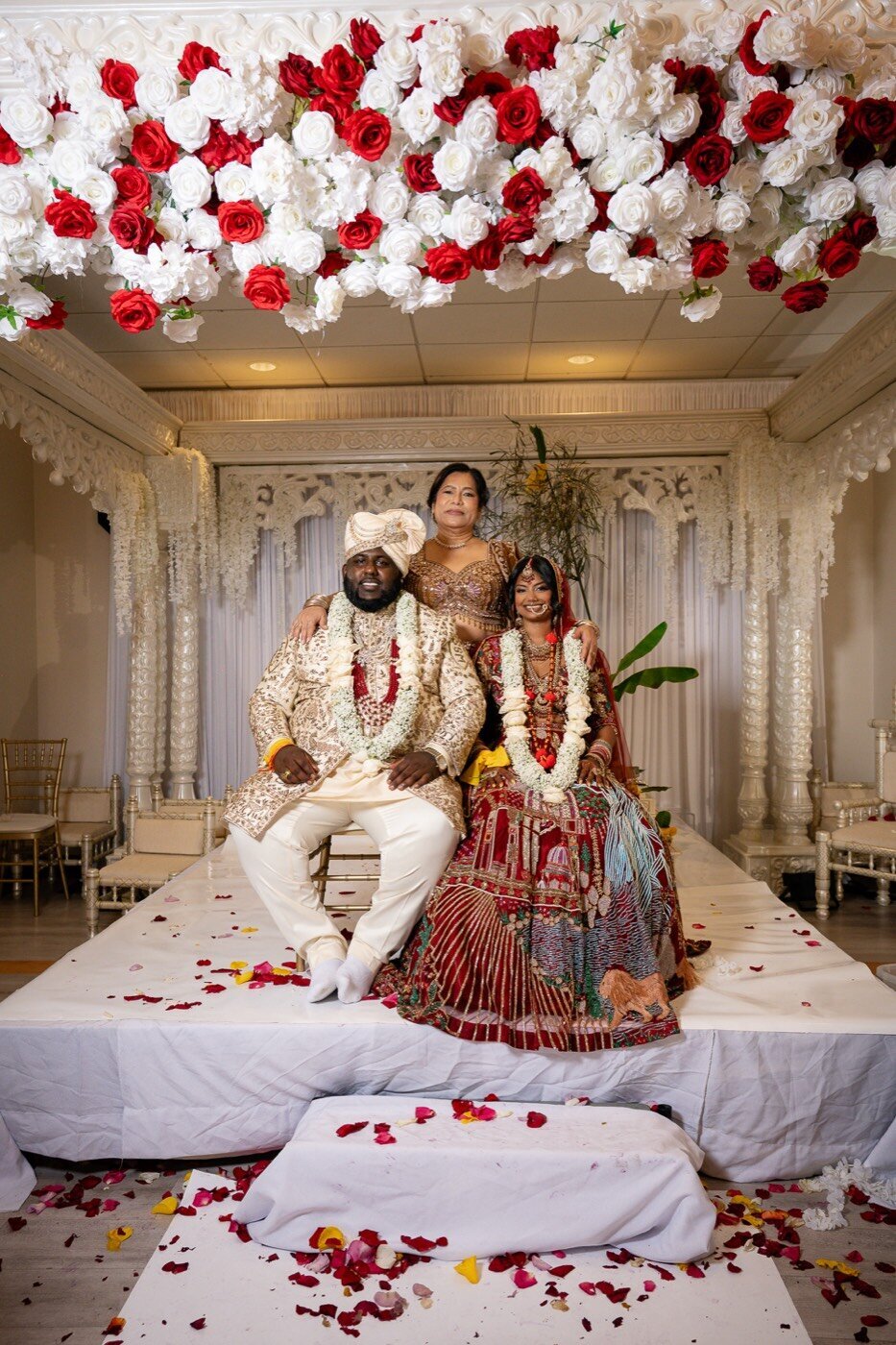
A one-day, 80-guest wedding is one thing. A multicultural wedding, or a Guyanese, Trini or Indian wedding that runs from the maticoor (matikor) and haldi through the ceremony, reception and kangan, is something else.
That's several setups, several guest lists, a pundit (or pandit), a priest or an officiant, outfit changes, food timing, and two families with their own traditions and their own expectations. Every one of those pieces depends on another one. When nobody is holding the full picture, small gaps turn into big stress, and big stress turns into family drama.
I've seen it from behind the camera, at weddings I was hired to shoot that had no planner: somebody who never showed up, a fight that almost broke out right before the reception walkout, someone switching the couple's entrance song at the last minute. None of that is rare. It's what happens when a hundred people and a dozen vendors share one room and nobody is holding the plan.
A good planner isn't there to pick your colors. They're there to be the calm voice in the room when everything is moving at once.
And there's one more moving part that never makes it onto the checklist.
The part nobody warns you about: who's paying gets a say
This one is personal. My wife and I got married in 2018, a Hindu and Christian ceremony on the same day. We didn't have the income to pay for everything ourselves, so we let people contribute. The venue was chosen for us. The food was chosen for us. The DJ was chosen for us. Pretty much all we did was show up. And the room was full of guests we honestly don't talk to today.
That wedding is the reason this business exists. Afterward, my wife said, "Let's do wedding planning," so other couples wouldn't lose their day the way we did.
That's not a bad family story. It's just how it works. Who pays plays a big part in who decides. If you take money, go in with your eyes open, and agree early on what that money covers and who makes the final call. I wrote a whole guide on this: Who Pays for the Wedding Gets a Say.
A planner helps here too. It's a lot easier for a planner to say "that's not in the timeline" than for a bride to say it to her own mother.

When you probably don't need a planner
So do you need one? I'd rather you hear this from me than overpay. You probably don't need one in these cases:
- A courthouse wedding or a small dinner with close family. (I actually think more couples should do this. More on that in Courthouse Wedding Now, Reception Later.)
- A short guest list at one venue that includes its own coordinator, and a family that's happy to stay hands-off.
- You genuinely enjoy logistics and have the time to treat it like a second job for a year.
Cynthia would push back on the "small" part, though: "A lot of people or a few people, it's the same stress." Even a small wedding still has vendors to manage and a schedule to keep.
When you really do
- More than 100 guests, or more than one day of events.
- Two cultures, two religions or two families with strong traditions.
- Lots of family contributing money, opinions or both.
- You both work full time.
- You want to actually be present on the day, not managing it.
Full planning, or just day-of?
You don't have to hire for everything. There are three levels:
- Full planning: from the first budget conversation to the last dance. Best for big or multi-day weddings. In Cynthia's words: "I'm with you from beginning to end. We look at the vision and the budget, and we set a budget for each thing: decor, food, invitations. I make the appointments with you and go to them with you. If we go over on one item, we come down on another. You're not going to be stuck with a massive bill at the end you weren't expecting. Nothing's going to slide under the radar." She also tracks every vendor's payment plan, so nobody is paid late, and her assistants run the day with her.
- Month-of coordination: you plan, then a coordinator takes over the details and vendors in the final weeks.
- Day-of coordination: someone runs the timeline and the vendors on the day so your family doesn't have to.
If budget is tight, day-of coordination is the one I'd never cut. Read How Much Does a Wedding Planner Cost in Orlando? for what each level usually runs.
The simplest way Cynthia explains the difference: "A wedding planner plans all the details, manages your budget and your financial stuff, and helps you choose your vendors. A coordinator comes along on the day to manage all the things you've already chosen." And on the day itself, a coordinator's job comes down to three things: "Keep the vendors organized, keep you on schedule, and keep the flow of the day."
What we do differently
At Marvelous Moments, Cynthia plans and coordinates, and she also leads our photo and film team on the day. So the person running your timeline is the same person making sure every moment gets captured.
Here's a real one. We had a couple doing their first dance on a cloud, with the low fog machine. The venue didn't have enough power for the machine, so Cynthia found an outlet outside the venue and we charged it there. Then, right as we unplugged it to follow the timeline, the family wanted to jump in with a surprise dance that wasn't planned. If that had happened, the machine would've run down and the moment would've been gone. Cynthia stepped in, told the family no, kindly, and had the couple go straight into their first dance. They got the cloud, we got the shot, and the family still got their dance after. That's what a planner is for.
Another one: at a wedding of about 180 guests, the person assigned to print the seating charts (a bridesmaid) waited too long, and they never got printed. At dinner, nobody knew where to sit. Cynthia's team pulled the chart up on a phone and told every guest, one by one, where to sit. "This should never happen if you have a wedding planner," she says. "But we solved it. Something's bound to go wrong. When it does, we come up with a plan and solve it."
And the reason she says it at all: "This is supposed to be a season of life you enjoy. You get married once. Why would you want to remember it in such a stressful way?"
Couples can book full planning, month-of or day-of coordination, or build their own package with her on a free Zoom.
Common questions
Is it worth hiring a wedding planner? For big, multicultural or multi-day weddings, yes. A planner saves you time, protects your budget from mistakes, and stands between you and the stress so you can enjoy your own wedding.
Can I plan my own wedding without a planner? Yes, if it's small and simple. Even then, hire a day-of coordinator so you and your family aren't running the event on the day.
What's the difference between a wedding planner and a day-of coordinator? A wedding planner helps you choose your vendors, plans the details and manages your budget for months. A day-of coordinator comes in on the wedding day to run everything you've already chosen: the vendors, the schedule and the flow of the day.
Do wedding planners help with family conflict? A good one does. They set the timeline, hold the boundaries you agreed on, and take the hard conversations off your plate.
Do I really need a wedding planner? It isn't a necessity, it's a luxury. As our planner Cynthia says, having one means you want to enjoy your wedding instead of turning it into a second job.
What does a day-of coordinator actually do? They keep the vendors organized, keep you on schedule, and keep the flow of the day, so you and your family aren't the ones running the event.
How far in advance should I book a wedding planner? Right after you get engaged, as soon as you're ready to start planning. A planner helps most with the early decisions: the budget, the venue and the first vendors.
Is a wedding planner worth it for a small wedding? Yes. Whether it's 40 guests or 400, the stress is the same: vendors to manage, a schedule to keep, and family to look after.